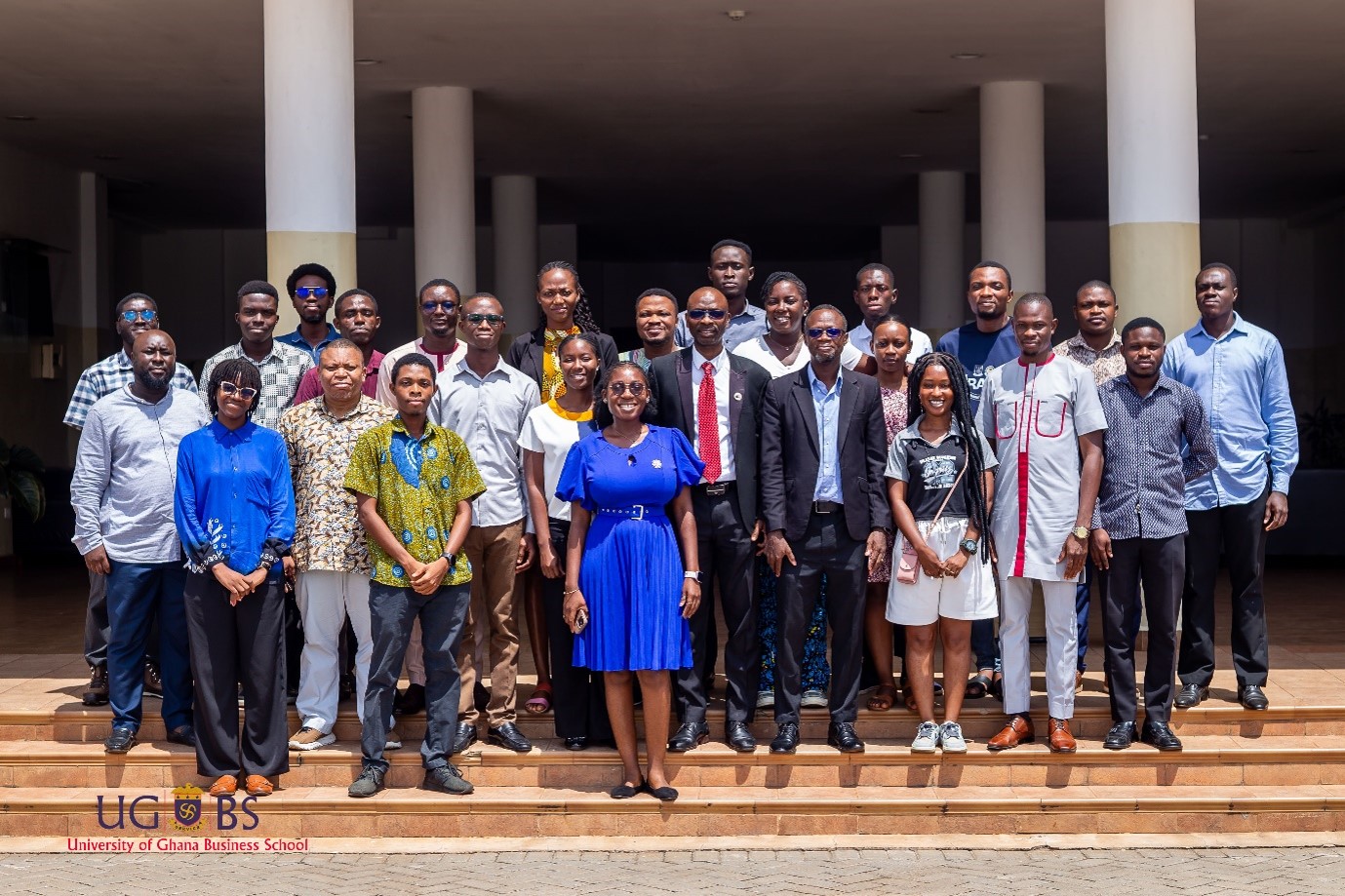
Transform Africa from Within (TaFW) Training Group Hosts Maiden STEG Graduate Students Workshop
The Transform Africa from Within (TaFW) Training Group, based at the University of Ghana Business School (UGBS), recently held its inaugural Structural Transformation and Economic Growth (STEG) workshop in partnership with the School of Graduate Studies (SGS). Hosted at the UGBS Graduate Building on June 2–3, 2026, the event was themed ‘Firm-Level Data Analysis and Designing Industrial Policy Interventions for Growth.’ It provided graduate students and early-career researchers with advanced training in empirical research and industrial policy. Participants explored empirical research methods and the principles of industrial policy design aimed at driving economic growth. Principal Investigator Prof. Edward Asiedu noted that the initiative is driven by a commitment to building research capacity and equipping the next generation of African scholars with the analytical tools necessary to tackle development challenges — both in Ghana and across the continent.

Prof. Edward Asiedu, Associate Professor of Development Economics and Finance, Department of Finance, University of Ghana Business School (UGBS)
The first day of the workshop was facilitated by Prof. Mohammed Amidu, Professor of Accounting and Finance at UGBS, and a member of TaFW. His session explored firm-level data analysis using cross-sectional and panel data, focusing on the specification and estimation of empirical finance models. He demonstrated their application in areas such as corporate governance, capital structure, payout policies, and investment. Drawing on Gatti and Love (2008) as a practical reference, Prof. Amidu guided participants through the analysis of firm-level data and highlighted some of the common challenges encountered in empirical research. These included omitted variable bias, where the exclusion of important factors can produce misleading results. To address these challenges, he introduced participants to various econometric techniques, including Instrumental Variables (IV), which use a third variable to isolate causal relationships and address endogeneity concerns arising from omitted variables and measurement errors. He also discussed the Generalised Method of Moments (GMM), a technique particularly useful in dynamic panel data analysis where past values of dependent variables may influence current explanatory variables.
Prof. Amidu further explained the estimation and application of dynamic panel models, emphasising that such models capture adjustments, persistence, and path dependence in firm behaviour over time. He noted that these approaches are increasingly important in understanding how firms respond to changing economic conditions and policy interventions. The session also explored major themes in empirical finance. Prof. Amidu explained that empirical finance applies mathematical, statistical, and econometric techniques to real-world financial data. Rather than relying solely on theoretical models, it employs observed data to test hypotheses, evaluate market behaviour, and inform financial decision-making. A significant portion of the discussion focused on capital structure and leverage determinants. Participants examined the factors that influence a firm's choice between debt and equity financing, including profitability, asset tangibility, firm size, growth opportunities, and liquidity. Drawing on the work of Abor (2008), Prof. Amidu explained how these determinants shape a firm's financial risk profile and overall value.

Prof. Mohammed Amidu, Professor of Accounting and Finance, University of Ghana Business School (UGBS)
The second day of the workshop was facilitated by Prof. Amin Karimu, Director of the Environmental Policy Research Unit and Professor of Economics at the School of Economics at the University of Cape Town. His session focused on Designing Firm and Industrial-Level Interventions to Drive Growth and he explained that structural transformation is central to Africa’s long-run development. According to him, the ultimate goal is for students to develop the ability to design rigorous empirical research papers alongside credible policy proposals grounded in evidence. The session was also structured around Africa’s growth challenges, production theory, diagnostic frameworks, policy interventions, industrial policy design, evaluation approaches, and research design for PhD-level work. Prof. Karimu explained the central role of firms in driving structural transformation and economic growth, noting that productivity gains arise through within-firm improvements, between-firm reallocation of resources, and entry-exit dynamics that reflect creative destruction.
He observed that in many African economies, these mechanisms are constrained by high informality, limited firm scaling, weak innovation capacity, and a dominance of small enterprises, often resulting in a “missing middle.” Against this background, he stressed that industrial policy should be understood as fundamentally a firm-level problem, centred on identifying which firms should grow, why they are constrained, and how policy can effectively remove those constraints. Participants were introduced to a five-pillar framework for assessing structural transformation, covering output structure, labour reallocation, productivity transformation, industrial sophistication, and inclusiveness. It was emphasised that changes in output structure alone do not necessarily translate into productivity-enhancing or inclusive transformation.
A diagnostic exercise on Ghana, South Africa, and Nigeria further illustrated differences in structural transformation performance and reinforced the need for more effective industrialisation strategies. Prof. Karimu also discussed production theory, focusing on firm heterogeneity, misallocation, financial constraints, learning barriers, and coordination failures. He introduced diagnostic tools such as enterprise surveys, value chain analysis, productivity measurement, and assessments of informality and infrastructure gaps. On policy design, he examined interventions in areas including access to finance, management practices, technology adoption, export expansion, and green upgrading. He further explored modern industrial policy instruments such as industrial clusters, industrial parks, public procurement systems, AfCFTA-driven opportunities, and green industrial policy frameworks. The session also covered a range of evaluation methods, including randomised controlled trials (RCTs), difference-in-differences (DiD), event studies, regression discontinuity designs (RDD), instrumental variables (IV), synthetic control methods, fixed effects models, and generalised method of moments (GMM), alongside productivity estimation techniques.
He stressed that effective growth policy in Africa should begin with a rigorous diagnosis rather than predetermined policy instruments. The discussion further highlighted the central role of firms in economic growth, noting that productivity growth occurs through within-firm improvements, efficient reallocation of resources between firms, and entry-exit dynamics that drive structural change. However, he cautioned that these mechanisms are often weak in African economies due to structural constraints such as informality, limited access to finance and technology, and the prevalence of small-scale enterprises, resulting in limited firm growth and a persistent “missing middle.”

Prof. Amin Karimu, Director of the Environmental Policy Research Unit and Professor of Economics at the School of Economics at the University of Cape Town, South Africa
Participants were cautioned against interpreting sales growth as direct evidence of productivity growth, as observed output changes may reflect input expansion rather than efficiency gains. He further noted that firm-level interventions must carefully distinguish between survival support and transformation-oriented growth, warning that indiscriminate SME targeting may subsidise inefficiency. The session concluded with group exercises that applied the concepts discussed to questions on GDP growth and structural transformation in Africa, reinforcing the link between empirical analysis, firm behaviour, and policy design.