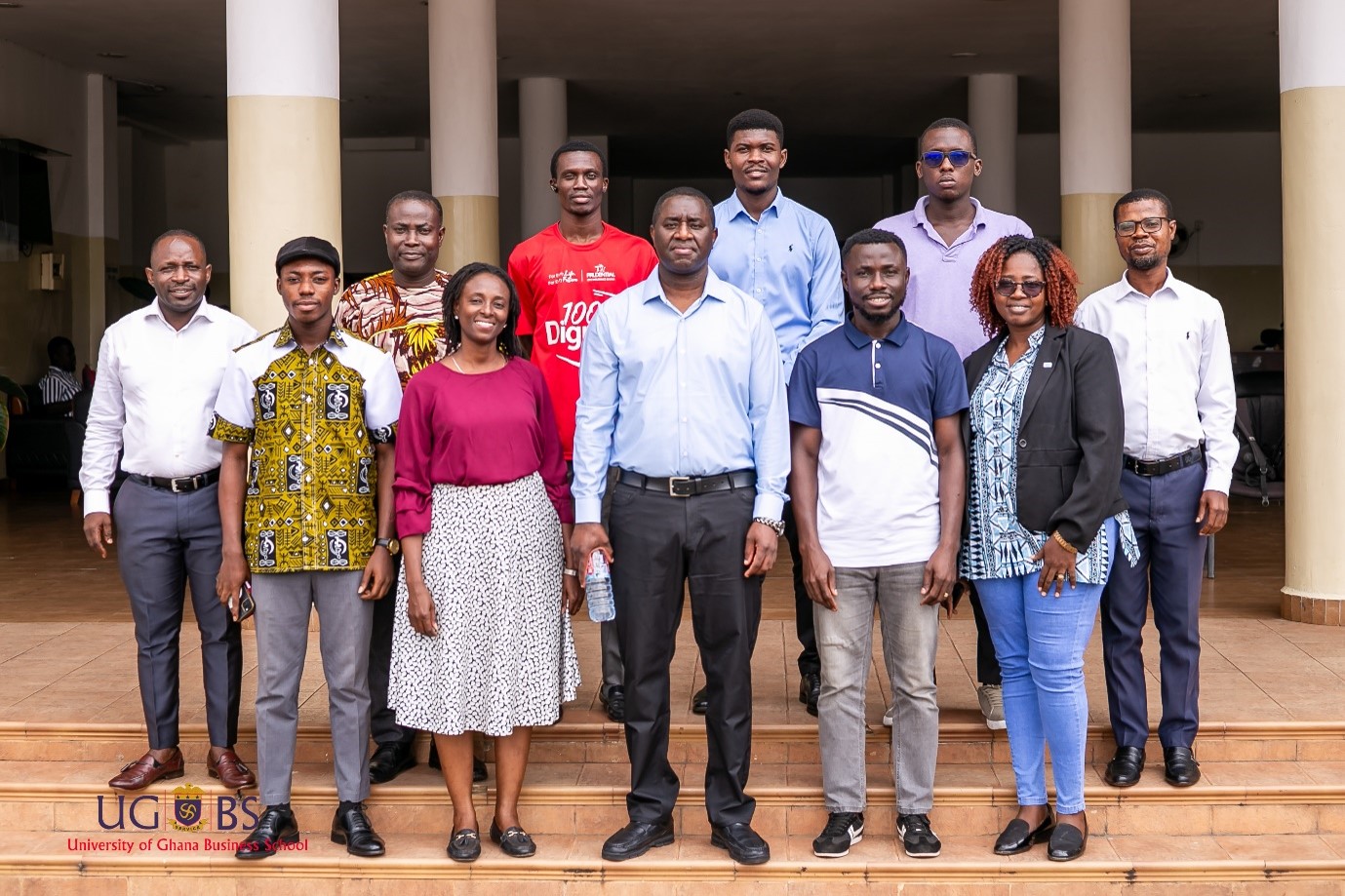
OHRM Organises Thesis and Research Consultation Seminar on Advanced Data Management and Statistical Analysis
The Department of Organisation and Human Resource Management (OHRM) at the University of Ghana Business School (UGBS) organised another session of its Thesis and Research Consultation Seminar, designed to equip postgraduate students already working on their thesis with advanced quantitative research and data analysis skills. The two-day seminar, held on 13th and 14th July 2026 at the UGBS Graduate Building, was facilitated by Prof. Rexford Abaidoo, Professor of Finance, Quantitative Data Analytics and Statistical Modelling at the University of Maryland Eastern Shore. The sessions focused on Data Management and Statistical Analysis in STATA, providing participants with practical knowledge to strengthen the quality and rigour of their thesis research.
Prof. Abaidoo introduced participants to effective data management techniques in STATA, covering data preparation, pre-estimation statistics, post-estimation analysis, hypothesis testing, formatting publication-quality tables, and the use of do-files to automate and reproduce statistical analyses efficiently. As part of the hypothesis testing session, participants were taken through several commonly used statistical tests in STATA and their applications in research. These included the paired samples t-test for comparing two related measurements such as before-and-after observations, the one-way ANOVA for comparing the means of three or more groups, the chi-square test for determining whether two categorical variables are related or independent, and correlation analysis for assessing the strength and significance of relationships between variables. Participants also practised the corresponding STATA commands and learned how to interpret their outputs.
The facilitator further demonstrated how to produce publication-ready statistical tables using STATA packages such as outreg, outreg2, eststo, esttab, and esttab using RTF output, explaining how researchers can present regression results in formats suitable for journal publications and academic theses. The session concluded with a practical demonstration on creating and managing STATA files to improve workflow efficiency and ensure that command codes can be saved and reused without repeating analyses from scratch.
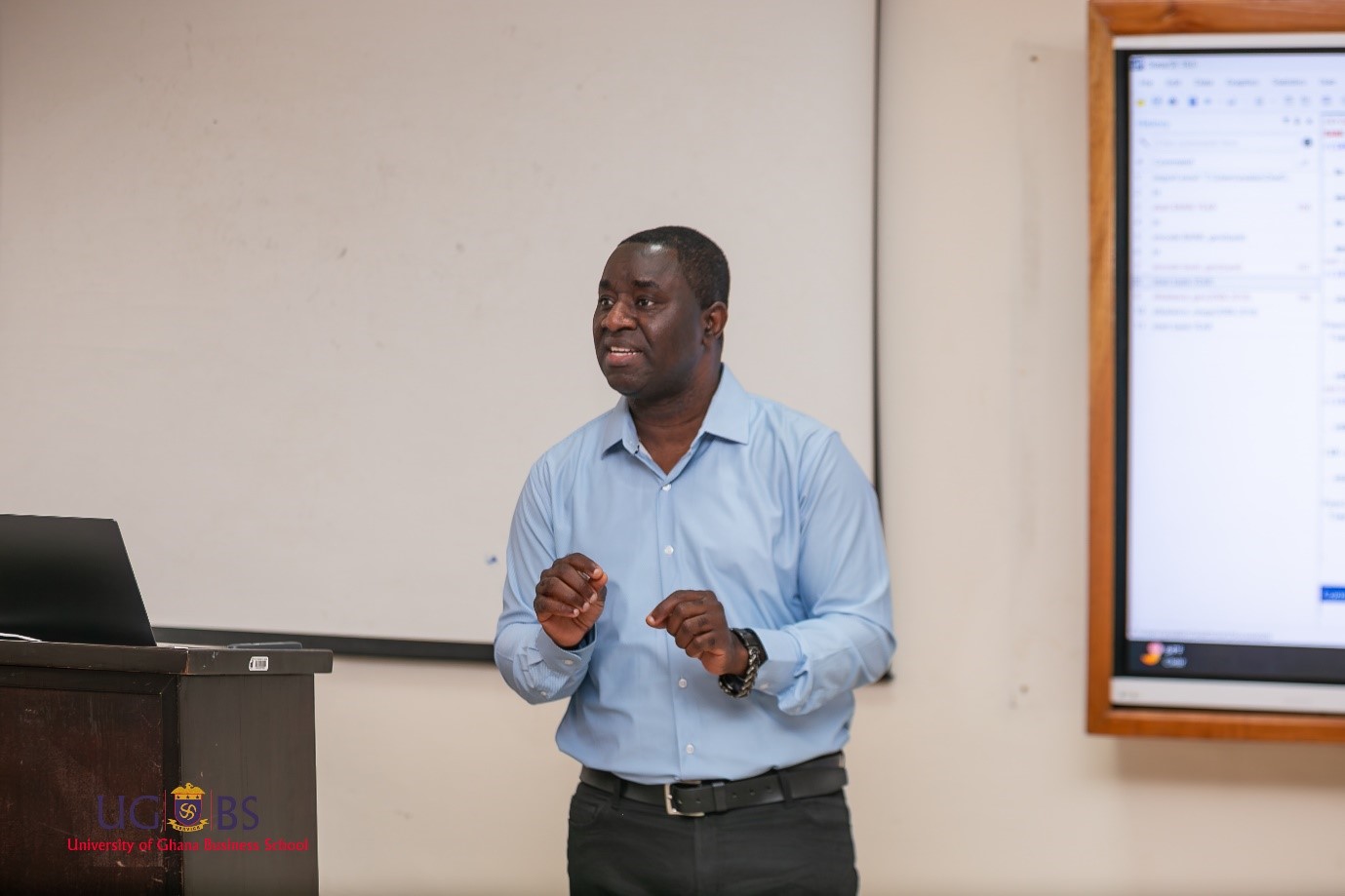
Prof. Rexford Abaidoo at the UGBS Advanced Data Management and Statistical Analysis seminar
The third session of the seminar focused on advanced econometric modelling techniques in STATA, including modelling moderation effects, fixed and random effects models, Autoregressive Distributed Lag (ARDL) models, Generalised Method of Moments (GMM) estimation, and the fundamentals of producing publishable statistical outputs. Participants were also introduced to survey data modelling in STATA, where they learned the fundamentals of survey analysis, the transition from survey instruments to data management, pre-estimation analysis, and post-estimation analysis. Through hands-on practical sessions, they gained experience in entering, managing, cleaning, examining, and analysing survey data using STATA.
A major component of the seminar focused on panel data modelling and analysis. Prof. Abaidoo explained the concepts of fixed effects and random effects models, highlighting their assumptions and applications. He noted that a fixed effects model assumes that the effects of explanatory variables remain constant across observations, making it suitable for estimating the specific impact of variables within a dataset. In contrast, a random effects model assumes that the effects of certain variables vary randomly across groups, allowing findings to be generalised beyond the observed sample while accounting for differences across groups. The seminar also explored panel ARDL modelling using the Mean Group (MG), Pooled Mean Group (PMG), and Dynamic Fixed Effects (DFE) estimators. Participants learned that Dynamic Fixed Effects ARDL models provide a robust framework for analysing dynamic relationships in panel data while controlling for unobserved heterogeneity. Prof. Abaidoo explained that the Mean Group estimator allows researchers to estimate both long-run and short-run coefficients for each cross-sectional unit, whereas the Dynamic Fixed Effects estimator provides overall long-run and short-run coefficients for the panel. He further noted that the Pooled Mean Group estimator assumes homogeneous long-run relationships while allowing heterogeneous short-run dynamics across cross-sectional units.
Prof. Abaidoo also introduced participants to the Generalised Method of Moments (GMM) estimation technique, explaining that it is a flexible estimation strategy that encompasses the classical method of moments, linear regression, and maximum likelihood estimation. He noted that GMM enables researchers to estimate econometric models without imposing restrictive assumptions about the distribution of error terms, making it particularly valuable for panel data analysis. Throughout the seminar, emphasis was placed on producing statistical outputs in publication-quality formats suitable for academic journals and graduate thesis. Participants were guided through practical demonstrations on developing reusable command files, enabling them to save and organise their analyses efficiently while ensuring consistency and reproducibility in future research.