
UGBS Seminar Series Examine Accounting and Accountability in Resource-Constrained Healthcare
The University of Ghana Business School (UGBS) has held the first presentation in its 2026 Seminar Series on Accounting and Accountability, examining how accounting practices shape perceptions of performance and accountability in resource-constrained healthcare systems. The seminar, held on 30th October 2026, at the UGBS Old Graduate Block, featured a presentation on the topic, “Accounting and Accountability at the Bottom of the Pyramid: A Bourdieusian Analysis of Practice and Misrecognised Symbolic Violence.” The presentation was delivered by Dr. Cletus Agyenim-Boateng of the Department of Accounting. Dr. Emmanuel Tetteh Asare, also of the Department of Accounting, moderated the session. In his opening remarks, he welcomed participants and announced that the seminar series would be held on the last Friday of every month. He explained that the UGBS Seminar Series will provide a platform for academic presentations and discussions on research and contemporary issues across relevant fields. The session brought together faculty members, Teaching Assistants and Graduate Assistants.
In his presentation, Dr. Agyenim-Boateng examined how accounting and accountability systems can conceal structural challenges within resource-constrained healthcare facilities by presenting the effects of inadequate resources as failures in local performance. Using the example of a district hospital, he illustrated the disconnect between reported performance and conditions on the ground. While a Key Performance Indicator (KPI) sheet may record whether facility targets have been met or missed, the reality in the hospital may include bare medicine shelves and patients being asked to purchase medicines from outside the facility. He argued that accounting is rarely neutral, as the systems and measures used to assess performance influence what is recognised as quality and whose account of institutional performance is considered credible. Drawing on the works of Hopwood (1983) and Miller and Power (2013), he explained that accounting does not merely record activities but also shapes how organisations and their performance are understood.

Dr. Emmanuel Tetteh Asare, moderating the 1st UGBS Seminar Series.
Providing a global context for the discussion, Dr. Agyenim-Boateng cited estimates indicating that approximately 4.5 billion people are not fully covered by essential health services, while poor-quality healthcare contributes to about five million deaths annually in low- and middle-income countries, referencing the World Health Organisation and World Bank (2023) and Kruk et al. (2018). Turning to Ghana’s healthcare system, he noted that approximately 25% of health expenditure is paid out of pocket, while 18.47 million people were enrolled in the National Health Insurance Scheme (NHIS), according to the National Health Insurance Authority (NHIA, 2024). He explained that the challenges associated with healthcare delivery cannot be understood solely through the performance of individual health facilities, as broader governance and financing decisions contribute to the conditions under which they operate. According to him, the situation reflects a chain in which institutions are counted but not necessarily held accountable for the structural conditions affecting their performance. He identified governance-related challenges, including conflicts of interest and dominance, as factors that can translate resource constraints into apparent failures at the facility level.
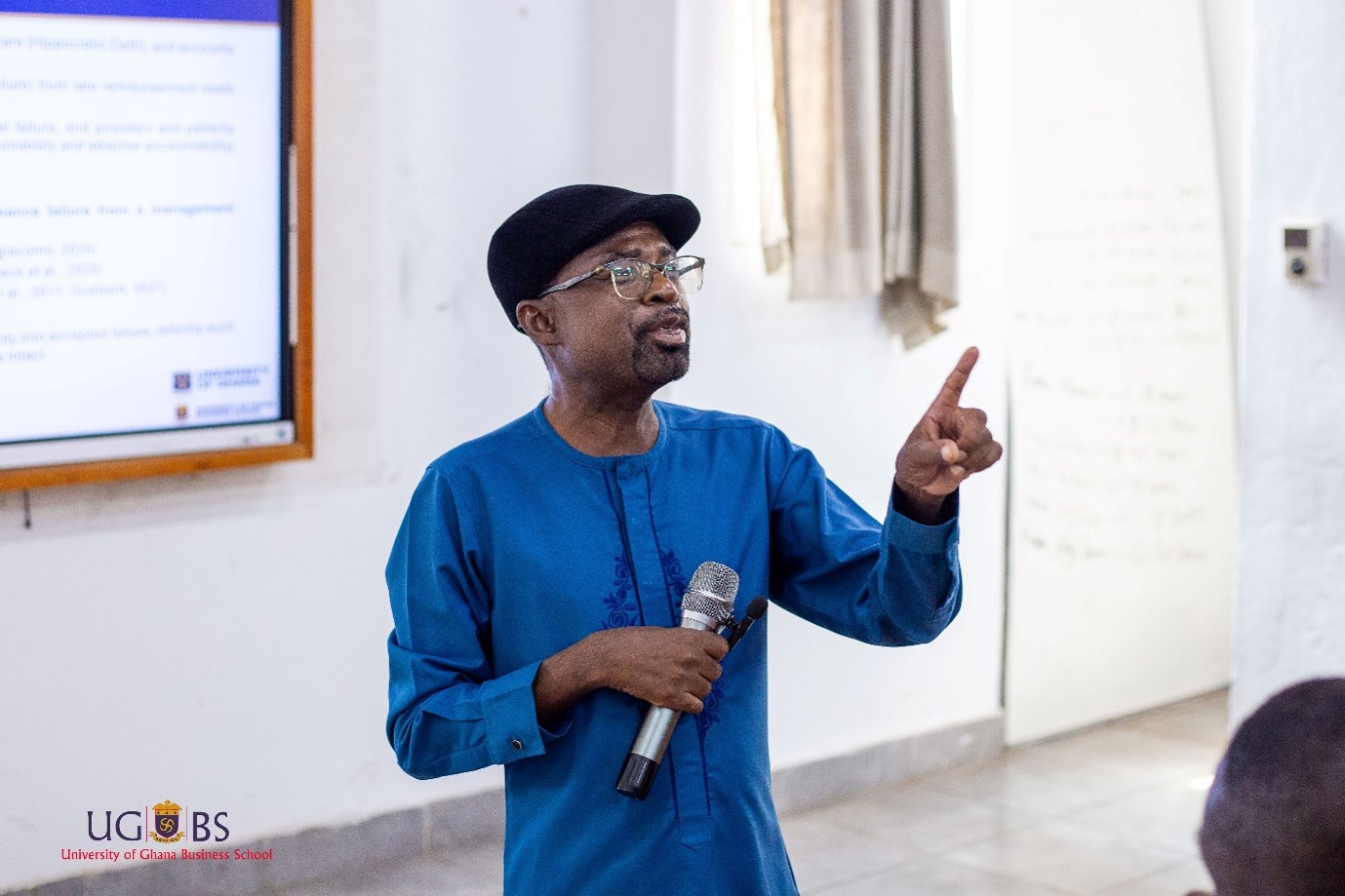
Dr. Cletus Agyenim-Boateng presenting at the 1st UGBS Seminar Series.
Dr. Agyenim-Boateng outlined some of the upstream financing challenges, including the capping of the National Health Insurance Levy (NHIL) in 2017, delays in claims payments, which he said take approximately four months instead of the stipulated 12 weeks, and arrears exceeding GH¢1 billion. He explained that these financing challenges affect the resources available to healthcare facilities, while accounting systems continue to apply similar performance indicators across facilities, irrespective of their resource capacities. Consequently, a facility’s inability to provide adequate access to medicines may be recorded simply as performance below target, without sufficient recognition of the underlying financing constraints. At the facility level, managers are then required to explain missed targets, healthcare providers are compelled to ration available services, and patients may be asked to purchase medicines outside the facilities. Dr. Agyenim-Boateng argued that unless there is a clear understanding of how accounting practices transform structural scarcity into acceptable institutional failure, policy reforms may increase funding without addressing the underlying accountability challenges. He cited the 2025 uncapping of the NHIL as an example, cautioning that additional resources alone may not correct the existing patterns of misrecognition. To explain these relationships, he drew on Pierre Bourdieu’s Theory of Practice, which examines how social structures, power relations and established practices influence people’s actions and perceptions within fields.
Presenting his research findings, Dr. Agyenim-Boateng identified some major issues through which accounting practices contribute to the normalisation and misrecognition of scarcity in healthcare delivery. The first finding, Accounting’s Normalisation of Scarcity: Universal Language of Performance Accountability, examined how standardised performance indicators are applied across healthcare facilities regardless of their resource capacities. He explained that this approach can transform a broader governance failure into what appears to be an individual facility’s failure to meet a target. The second finding, Capital Becomes Credibility, explored how differences in institutional resources and advantages influence whose performance is recognised as credible. Dr Agyenim-Boateng explained that existing advantages become visible and count towards institutional credibility, while the disadvantages faced by resource-constrained facilities remain largely invisible. The third finding, Scarcity Internalised as Normal, examined how persistent resource shortages become accepted as part of everyday healthcare practice. He explained that both healthcare providers and patients gradually adjust to these conditions, with compromises in service delivery becoming normalised rather than recognised as consequences of structural constraints. The fourth finding, Misrecognition and Symbolic Violence, focused on how structural exclusion is experienced and interpreted at the individual level. He explained that symbolic violence occurs when systemic disadvantages are accepted as personal circumstances or inevitable outcomes, rather than being recognised as products of broader institutional and governance arrangements.

Some participants at the 1st UGBS Seminar Series.
In his conclusion, Dr. Agyenim-Boateng maintained that accounting does not create scarcity but influences how scarcity is interpreted and represented, particularly when its structural causes are misrecognised. He argued that what accounting systems currently describe as local institutional failure could instead be recognised and reported as the outcome of broader governance decisions. This, he noted, presents an opportunity to rethink accountability frameworks to ensure that performance assessments take into consideration the resource conditions and structural factors affecting healthcare delivery.